
Pruning
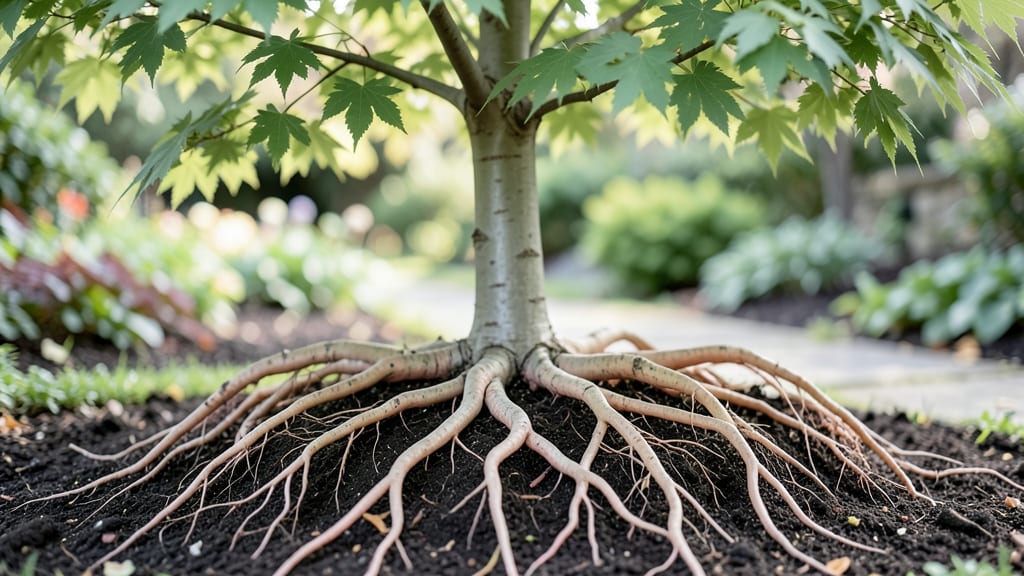
The Japanese maple tree’s root system is a delicate network that determines its stability, health, and lifespan—so understanding it is the key to growing a thriving specimen.
Did you know your Japanese maple’s delicate beauty starts underground? Its shallow root system demands careful planning—or risk stunted growth, soil erosion, or even tree collapse.
Unlike deep-rooted trees, this ornamental favorite spreads wide and shallow, making soil choice and spacing critical. Plant too close to structures or other trees, and you’ll end up with girdling roots or an unstable trunk.
In this guide, I’ll break down how to nurture those roots for a strong, centuries-old tree—from ideal soil conditions to pruning tips that protect long-term health.
How Japanese maple roots spread shallowly & what it means for planting
Japanese maples develop a fibrous, wide-spreading root system rather than a deep taproot. This unique structure spreads horizontally within the top 12-18 inches of soil, creating a dense network that stabilizes the tree but demands careful planting.
Unlike oak or pine trees, their roots rarely extend deeper than 24 inches, making them sensitive to soil compaction and improper depth.
The shallow nature of these roots explains why Japanese maples often struggle when planted too deeply. Studies show that girdling roots (roots circling the trunk) occur in 30% of improperly planted specimens, leading to stunted growth or even tree death.
Proper planting depth is critical—roots should sit just 1-2 inches below soil level at the base of the trunk.
| Root Feature | Key Details | Planting Impact |
|---|---|---|
| Root Type | Fibrous, shallow | Spreads 3-5x canopy width |
| Max Depth | 12-18 inches | Risk of girdling if planted too deep |
| Ideal Spacing | 15-25 feet apart | Prevents root competition |
| Soil Depth | 12+ inches loose | Critical for stability |
| Common Mistake | Planting too deep | Causes trunk suffocation |
For mature Japanese maples, the canopy width dictates spacing needs. A 15-foot-wide canopy requires 45-75 feet of space between trees to prevent root competition. This rule applies to both dwarf varieties (scaled down proportionally) and standard-sized trees.
Skimping on space leads to root crowding, which weakens the tree’s ability to absorb water and nutrients.
Another critical factor is soil aeration. Compacted soil restricts root expansion, causing stress visible as yellowing leaves or slow growth. To test soil depth, dig a hole 18 inches deep before planting—if you hit hardpan, amend with compost or sand to improve drainage.
Japanese maples thrive in well-aerated, slightly acidic soil (pH 5.0-6.5).
When planting, avoid the common mistake of burying the trunk too deeply. The root flare (where roots meet the trunk) should sit just above soil level.
Over-deep planting suffocates roots, while planting too shallow exposes them to drying winds. Use a stake only if necessary—over-staking can damage roots during removal.
Japanese maples also benefit from mulching around the base, but keep mulch 2-3 inches away from the trunk to prevent moisture buildup. A 3-inch layer of organic mulch (like wood chips) retains moisture while protecting roots from temperature extremes.
This practice mirrors their natural forest-floor habitat, where leaf litter insulates roots.
Root health directly impacts leaf color and vigor. Stressed roots produce pale or yellow leaves, while thriving roots support vibrant foliage. If you notice cracking bark or leaning, it may signal root instability.
In such cases, gently loosen compacted soil around the root zone and water deeply to encourage expansion.
For container-grown Japanese maples, the root ball should never dry out. These trees have limited root space, so watering every 5-7 days is essential. Use a well-draining potting mix with perlite or orchid bark to prevent waterlogging, which can cause root rot in the confined space.
Understanding your Japanese maple’s shallow root system transforms planting from guesswork to precision. By respecting its natural growth habits—wide spread, shallow depth, and aerated soil—you’ll cultivate a tree that thrives for decades.
The key is patience: roots take 2-3 years to fully establish, so avoid disturbing the area during this critical period.
Soil health secrets: pH, drainage & mulching for Japanese maple roots
Your Japanese maple’s delicate foliage depends entirely on its root health. The right soil conditions—like acidic pH (5.0–6.5) and moisture-retentive yet well-draining mixes—prevent root rot and drought stress.
Without these, your tree may struggle to absorb nutrients, leading to yellowing leaves or weak growth. Let’s dig into the science behind happy roots.
Japanese maples thrive in loamy, slightly acidic soils rich in organic matter. A pH below 5.0 or above 6.5 locks out essential nutrients like iron and manganese, causing chlorosis (yellowing leaves).
Test your soil annually—especially in alkaline regions—and amend with peat moss or pine bark to lower pH naturally. Avoid lime or wood ash, which raise pH and harm roots.
🌱 Ideal Soil Conditions vs. Problematic Soils
✅ Ideal Soil
- pH 5.0–6.5: Acidic, nutrient-rich
- Well-draining: Prevents waterlogging
- Moisture-retentive: Holds water without sogginess
- Organic matter: 20–30% compost or peat
- Aerated: Loose texture for root expansion
❌ Problematic Soil
- pH >7.0: Alkaline, nutrient-deficient
- Clay-heavy: Compacts, suffocates roots
- Sandy: Drains too fast, drought-prone
- Waterlogged: Causes root rot
- Low organic matter: Poor nutrient retention
For drainage, mix equal parts topsoil, compost, and perlite to create a well-aerated medium. Avoid heavy clay soils—amend with coarse sand or bark chips to improve porosity.
Japanese maples hate soggy feet; ensure the planting hole has drainage holes if using containers, and elevate roots slightly in ground beds to prevent water pooling.
Mulching is non-negotiable for root health. Organic mulches like shredded bark or leaf mold (2–4 inches deep) improve soil structure over time, while inorganic mulches (gravel, rocks) reflect heat—ideal for hot climates.
Apply mulch 2–3 inches from the trunk to avoid girdling and retain moisture. Replenish annually, as organic mulch breaks down.
Watch for root rot signs: wilting despite moist soil, mushroom growth near the base, or a foul odor. These indicate overwatering or poor drainage. Conversely, drought stress shows as crispy leaf edges or leaf drop.
Adjust watering to deep, infrequent soaks (every 7–10 days in summer) and monitor soil moisture with a finger—top 2 inches should stay slightly damp.
Pro tip: Mulch volcanoes (piling mulch against the trunk) trap moisture and invite pests. Keep mulch flat and even, sloping away from the base. Pair this with drip irrigation to deliver water directly to roots, reducing evaporation and fungal risks.
With these tweaks, your Japanese maple’s roots will thrive for decades—just like its stunning foliage deserves.