
Plants
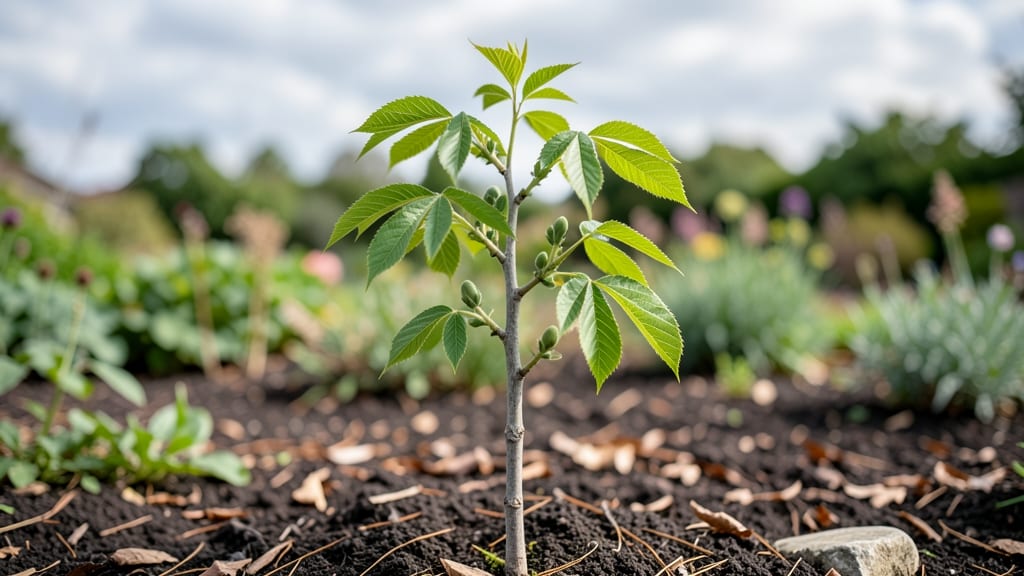
A young walnut tree looks like a slender, upright sapling with smooth grayish-brown bark and compound leaves featuring 5-9 oval leaflets that have serrated edges and a fresh, light green color.
A young walnut tree's most distinctive feature is its pinnate leaves, which grow in clusters of 5-9 leaflets arranged like fingers on a hand. 🌿 The bark starts smooth and matures into a more rugged texture as the tree ages, while the slender branches create a delicate framework that supports the lush foliage.
These early growth characteristics help gardeners distinguish walnut seedlings from similar species like hickory or butternut, which often have fewer leaflets or different bark patterns.
During the first few years, walnut trees grow slowly but steadily, developing a strong root system that anchors them for decades. They thrive in full sunlight and well-draining soil, making them ideal for open landscapes.
Understanding these growth patterns helps you provide the right care—like proper watering and pest control—to ensure your young walnut tree matures into a majestic specimen.
💡 In This Article
- Identifying Walnut Tree Leaf and Bark Characteristics
- Early Growth Stages and Care for Young Walnut Trees
Identifying walnut tree leaf and bark characteristics
The compound leaves of a young walnut tree are its most defining feature, with 5-9 leaflets arranged alternately along a central stem (rachis). Each leaflet measures about 2-5 inches long and 1-2 inches wide, with finely serrated edges that give them a delicate, almost lace-like appearance.
The upper surface is a vibrant light green, while the underside has a slightly paler, almost silvery hue due to fine hairs along the veins. 🌿 These leaflets grow in a pinnate pattern, resembling a feather or hand with fingers.
The bark of a young walnut tree starts as a smooth, grayish-brown surface, often with subtle horizontal lenticels (pores) that allow gas exchange. As the tree matures, the bark develops deeper grooves and ridges, creating a more rugged texture by the time it reaches 10-15 years old.
This early smoothness helps distinguish walnut seedlings from hickory trees, which typically have shaggier bark even at a young age. The branches are slender and upright, growing at 30-45 degree angles from the trunk, forming a graceful, open canopy.
One key identifier is the juglone compound in walnut leaves, which gives them a faint, slightly bitter aroma when crushed—a trait shared with black walnut but not with butternut trees.
The leaf arrangement also differs: walnut leaves grow in opposite pairs along the stem, while hickory leaves often have 3-5 leaflets arranged differently. Pay attention to these details when distinguishing seedlings in nurseries or wild settings.
Color variations occur seasonally. In spring, new leaves emerge a bright reddish-green before maturing to their summer shade. Fall brings a stunning transformation—walnut leaves turn yellowish-brown before dropping, unlike hickory leaves that often stay green longer.
This seasonal change is another clue for identification. The tree's slow growth rate (12-24 inches per year in early years) also sets it apart from faster-growing species.
For gardeners, recognizing these traits early helps with proper spacing. Walnut trees need 40-60 feet of space at maturity, so identifying seedlings correctly prevents overcrowding. The compound leaves' arrangement and bark texture are your best tools for accurate identification in the field. 🌱