
Propagation
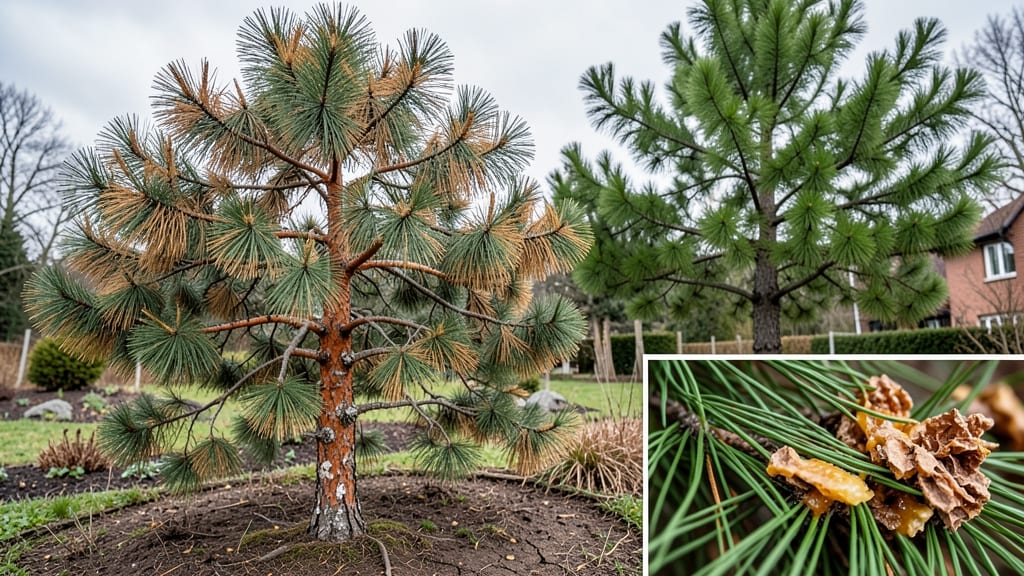
Your pine tree dying from the top down isn’t just bad luck—it’s often a fungal infection like Fusarium wilt or root rot stealing nutrients from the top down. 🌲 I’ve nursed back more than a few of these giants by cutting out the deadwood, fixing drainage, and applying the right fungal treatments.
The key? Acting fast before the disease spreads to the whole tree.
First, confirm it’s fungal by checking for yellowing needles, mushrooms at the base, or a spongy trunk when pressed. Environmental stress—like soggy soil or compacted roots—makes pines vulnerable, so improve airflow and drainage immediately.
Prune only the dead branches (sterilize your tools!) to stop the spread, and avoid over-fertilizing, which stresses the roots further.
With the right mix of soil amendments (like compost and sand) and a targeted fungicide, you’ll see fresh green growth within 6-12 weeks. The goal is to revive the roots so the tree can push out new needles from the bottom up.
It’s a slow process, but with patience, your pine can bounce back—even if it’s been struggling for years.
Prevention is easier than rescue: mulch properly, avoid overwatering, and monitor for pests like bark beetles, which weaken trees. If your pine’s already in decline, this guide gives you the exact steps to turn things around—before it’s too late.
Root Causes Behind Top-Down Pine Decline
When your pine tree starts shedding needles from the top down, it’s rarely a coincidence—it’s a distress signal. Understanding the why behind this pattern is the first step to saving your tree.
Below, we break down the most common culprits, backed by science, and explain how they trigger this specific type of dieback.
Fungal pathogens are the #1 reason pine trees exhibit top-down decline, especially in root rot scenarios. These microscopic invaders thrive in moist, oxygen-deprived soil and attack the tree’s vascular system, disrupting nutrient and water flow.
- Armillaria root rot (Honey Mushroom): This aggressive fungus spreads via underground rhizomorphs (thread-like structures) and blocks water uptake in the roots. As the roots fail, the tree’s crown (top) suffers first because it’s the last part to receive limited resources.
- Phytophthora spp.: Water-loving fungi like Phytophthora cinnamomi thrive in soggy soil and infect fine root hairs. The tree’s defense mechanisms seal off infected roots, creating a "barrier zone" that strangles the top canopy.
- Leptographium wageneri (Blue Stain Fungus): Often introduced via bark beetle infestations, this fungus clogs the tree’s xylem (water-conducting tissue). The top needles, being the farthest from the roots, brown first due to starvation.
💡 Pro Tip: If your soil stays wet for weeks or you’ve had recent construction (compacted soil = poor drainage), fungal root rot is likely. Look for mushrooms at the base or a sweet, musty smell in the soil—these are red flags.
Pines are drought-tolerant, but extreme moisture imbalances—whether from overwatering or prolonged dry spells—can trigger top-down dieback. Here’s how:
| Cause | Mechanism | Signs to Watch For |
|---|---|---|
| Overwatering | Excess water displaces oxygen in the soil, suffocating roots and promoting anaerobic bacteria. Roots rot, and the tree can’t translocate water to the top. | Mushrooms at the base, soggy soil, needles turning yellow/brown from the top. |
| Drought Stress | Prolonged dry conditions cause the tree to "abscise" (shed) older needles to conserve water. Since older needles are at the top, dieback starts there. | Needles turning straw-colored, brittle, and falling easily; soil pulled away from the trunk. |
| Frost or Winter Desiccation | Cold winds dry out the top canopy faster than the roots can replenish moisture. Common in evergreens like pines. | Needle browning on the windward side; soil remains moist but needles crisp. |
🌡️ Actionable Fix: Check soil moisture 2–3 inches deep—if it’s damp but not soggy, you’re golden. For drought stress, deep watering (1–2 inches per week) with a soaker hose mimics natural rainfall. For overwatering, improve drainage with organic matter (compost or pine bark mulch).
Insects like bark beetles and pine needle scale don’t just nibble—they disrupt the tree’s entire system. Their damage often starts unseen in the roots or lower branches, leading to top-down decline.
- Bark Beetles (e.g., Dendroctonus spp.):
- Lay eggs under the bark, and their larvae tunnel into the phloem (nutrient-transport layer).
- The tree’s pitch (resin) response clogs the xylem, starving the top canopy.
- Tell-tale sign: Sawdust-like frass at the base of the tree or D-shaped exit holes.
- Pine Needle Scale:
- These tiny pests suck sap from needles, weakening the tree’s photosynthetic ability.
- Heavy infestations force the tree to shed needles from the top down to reduce energy loss.
- Tell-tale sign: Sticky honeydew on lower branches and black sooty mold.
🔥 Pest Control Tip: For beetles, remove and burn infested branches immediately. For scale, blast off infestations with a strong hose spray or apply horticultural oil in dormant season (fall/winter).
Pines are heavy feeders, especially in poor or compacted soil. When they lack critical nutrients, the top canopy—being the most metabolically active—shows symptoms first.
| Deficiency | Symptoms | Solution |
|---|---|---|
| Nitrogen (N) | Pale yellow needles (top-down), stunted growth, sparse foliage. | Apply slow-release nitrogen (e.g., blood meal or composted manure). |
| Magnesium (Mg) | Yellowing between needle veins (interveinal chlorosis), starting at the top. | Sprinkle Epsom salt (magnesium sulfate) around the drip line in early spring. |
| Boron (B) | Dieback of new growth, brittle needles, and blackened tips. | Use a boron supplement (follow label rates). |
🎯 Soil Test First: Before fertilizing, test your soil’s pH and nutrient levels (pH 5.0–6.5 is ideal for pines). Over-fertilizing can burn roots, worsening the problem.
Next, we’ll dive into diagnosing your specific case and the fungal fix to rescue your pine’s roots. Stay tuned!
Revive Your Pine Tree Now
---
If your pine tree is showing signs of dying from the top down, don’t panic—there’s still hope! The key is acting fast and addressing the root cause (literally).
Below are practical, step-by-step solutions tailored to common culprits like root rot, fungal infections, or environmental stress. Each fix includes prevention tips to keep your pine thriving long-term.
---
Before treating, confirm the problem: - Check the needles: Are they brown, brittle, or falling off? Root rot or fungal infection often causes yellowing/browning at the top first. - Inspect the trunk: Soft, discolored, or spongy wood? That’s a red flag for rot. - Look at the soil: Is it waterlogged, compacted, or cracked? Poor drainage is a common trigger.
Pro Tip: 💡 Use a small knife to scrape the bark—healthy tissue is firm and greenish; rotten tissue smells foul and feels mushy.
---
If the problem is root rot or fungal spread (like Armillaria or Phytophthora), follow these steps:
#### 👨🍳 H3: Improve Drainage Immediately
Waterlogged soil suffocates roots. Act fast:
- ⏰ Stop watering for at least 2 weeks unless the soil is bone-dry.
- 🔪 Aerate the soil: Dig 6–12 inches deep around the base (but avoid damaging roots). Mix in perlite, sand, or compost to loosen it.
- 🌡️ Raise the tree’s base: If planting in a container, add a layer of gravel or bark chips to prevent future sogginess.
#### 🌱 H3: Apply Fungicide (If Needed)
For fungal infections, use a copper-based fungicide or hydrogen peroxide (3%) spray:
- 💦 Spray the top 1/3 of the tree (where symptoms appear) and the soil around the base.
- 📅 Repeat every 2–4 weeks until new growth appears.
- ✨ Prevention tip: Apply fungicide proactively in spring/fall to ward off future outbreaks.
#### 🪓 H3: Prune Dead Branches Carefully
Remove only the most severely damaged top branches to reduce stress:
- 🔪 Use sterilized pruners to cut just above a healthy bud or branch collar.
- 🚫 Never remove more than 25% of the canopy—this weakens the tree further.
- 🗑️ Dispose of pruned branches off-site to prevent spreading disease.
---
A stressed pine needs extra care to recover:
#### 💪 H3: Fertilize Smartly
Use a balanced, slow-release fertilizer (10-10-10 or 20-20-20) in early spring:
- 📊 Apply half the recommended dose—over-fertilizing burns roots.
- 🥗 For organic options, try fish emulsion or compost tea for a gentle nutrient boost.
- 🎯 Prevention tip: Test soil pH (pines prefer acidic soil, pH 4.5–6.0). Amend with sulfur if needed.
#### ☀️ H3: Adjust Watering Habits
Pines hate soggy feet but also need consistent moisture:
- 💦 Water deeply 1–2 times per week (not daily). Let the top 2 inches of soil dry between waterings.
- 🌧️ Use a soaker hose or drip irrigation to deliver water slowly at the base.
- 🚫 Avoid wetting foliage—this encourages fungal growth.
#### 🏡 H3: Protect from Environmental Stress
Pines are tough but need the right conditions:
- 🌳 Shade relief: If your tree is in deep shade, thin nearby foliage to allow at least 6 hours of sunlight daily.
- 🌬️ Windbreaks: Plant a hedge or use a windbreak fence if your area is exposed to harsh winds.
- 🐛 Pest control: Check for pine bark beetles or sawflies—treat with neem oil if detected.
---
Once your pine recovers, keep it healthy with these habits:
- 🔄 Mulch properly: Spread 2–4 inches of pine bark mulch around the base (keep it 6 inches away from the trunk).
- 🌧️ Improve drainage: If your yard floods, consider French drains or raised beds.
- 📅 Monitor annually: Inspect for early signs of stress in spring and fall.
Remember: 🌲 Pines are resilient! With the right care, many trees recover fully within 1–3 years. If your tree is severely decayed (e.g., hollow trunk, no new growth after a year), consult an arborist—some cases may require removal to protect other plants.
Frequently asked questions
Why does my pine tree always die from the top down instead of the bottom?
This pattern happens because the top canopy is the last part to receive nutrients and water when the roots are struggling. Fungal infections like root rot or pests often block water flow in the vascular system, causing the tree to prioritize lower branches where resources are more accessible. Think of it like a straw with a kink—the water gets cut off at the top first.
Can I save a pine tree if mushrooms are growing at its base?
Mushrooms at the base are a red flag for Armillaria root rot or similar fungal infections. You can still try to save it by improving drainage, applying copper-based fungicide, and pruning dead branches—but recovery isn’t guaranteed. If the trunk feels soft or hollow when pressed, the tree may be beyond saving and should be removed to prevent spreading.
How long does it take to see improvement after treating a dying pine?
With proper care—like fixing drainage, applying fungicide, and adjusting watering—you should see new growth within 6-12 weeks. However, severe cases may take up to 2-3 years for full recovery. Monitor the tree’s progress and adjust treatments as needed. Patience is key, especially if the roots were heavily damaged.
Will pruning help a pine tree recover, or will it make it worse?
Pruning can actually help if done correctly! Remove only the dead or severely damaged top branches (never more than 25% of the canopy) to reduce stress. Sterilize your tools between cuts to prevent spreading disease. Avoid heavy pruning—it weakens the tree further while it’s already struggling.
Is there a way to prevent this from happening again?
Improve drainage by amending soil with sand or compost, mulch properly (but keep it 6 inches away from the trunk), and avoid overwatering. Test soil pH annually (pines prefer pH 4.5-6.0) and apply fungicide preventatively in spring/fall. Regularly check for pests like bark beetles and treat early if detected.