
Light Requirements
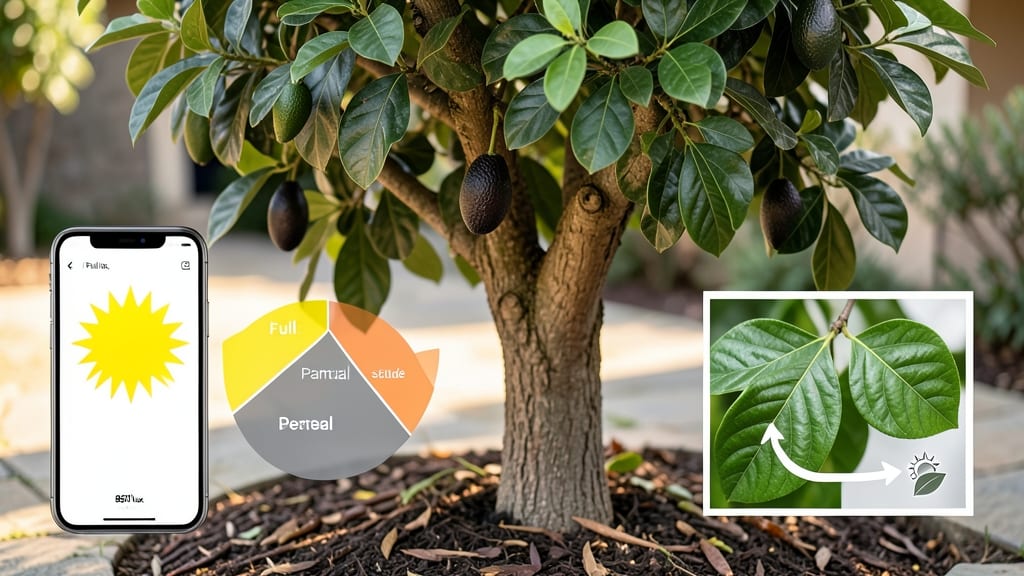
An avocado tree needs 6 to 8 hours of sunlight daily to thrive, though mature trees can handle up to 10+ hours in ideal conditions 🥑.
Wondering why your avocado tree isn’t thriving? Sunlight exposure could be the missing piece—too much or too little can stunt growth, reduce fruit yield, or even kill your tree.
Young seedlings need gentle, indirect light to avoid leaf scorch, while mature trees crave full sun for optimal fruit production. But here’s the catch: regional climate and indoor vs. outdoor growing change the rules.
In this guide, I’ll break down the exact sunlight needs for every growth stage, plus how to spot (and fix) signs of over- or under-exposure—so you can keep your avocado tree happy and healthy.


Avocado tree sunlight requirements by growth stage: seedling to mature tree
Growing a thriving avocado tree starts with understanding its sunlight needs, which change dramatically from seedling to mature tree. Too little light stunts growth, while too much can scorch delicate leaves.
The key is matching your tree’s stage to the right light exposure—whether indoors or outdoors. Let’s break down the science-backed requirements for each phase.
Avocado trees are sun-worshippers, but their tolerance varies by age. Seedlings need gentle indirect light to avoid stress, while mature trees crave 8+ hours of full sun for fruit production.
Even indoor growers must replicate this progression carefully. Without proper light, you’ll see yellowing leaves, weak stems, or no fruit—so let’s fix that today.
| Growth Stage | Sunlight Needs | Indoor Adjustments | Outdoor Placement |
|---|---|---|---|
| Seedling (0-2 years) | 6+ hours indirect light | South-facing window + grow lights | Dappled shade (morning sun only) |
| Juvenile (2-5 years) | 6-8 hours partial sun | Grow lights 10-12 hrs/day | East/west exposure or filtered sun |
| Mature (5+ years) | 8+ hours full sun | Not recommended (needs outdoor space) | South-facing, no shade after 10 AM |
Your seedling avocado tree (0-2 years old) needs 6+ hours of indirect sunlight daily. Place it near a south-facing window or under grow lights for 10-12 hours if indoors.
Outdoor seedlings thrive in dappled shade—think morning sun only—to prevent leaf burn. Skipping this step often leads to leggy, weak stems that can’t support future fruit.
As your tree enters the juvenile stage (2-5 years), increase exposure to 6-8 hours of partial sun. This means 3-4 hours of direct sun paired with filtered light. In containers, rotate the pot weekly for even growth.
Outdoor trees in subtropical zones (like USDA Zone 9) can handle afternoon shade, while tropical climates may need afternoon shade cloth to prevent heat stress.
Mature avocado trees (5+ years old) demand 8+ hours of full sun for optimal fruit production. Without this, you’ll see small, poor-quality avocados or none at all.
In tropical climates, trees can handle direct midday sun, but subtropical growers should protect leaves from intense afternoon rays using light shade cloth (30-50%). Indoor mature trees? Not ideal—they’ll never fruit properly.
Climate plays a huge role in sunlight needs. In tropical zones (Zones 10-11), avocados tolerate direct sun year-round, but subtropical zones (Zones 8-9) require morning sun only during summer. Use a light meter ($20 on Amazon) to measure foot-candles—ideal levels are 2,000-5,000 fc for healthy growth.
If your reading drops below 1,000 fc, supplement with LED grow lights.
Watch for leaf color changes to gauge sunlight success. Dark green leaves mean perfect light; yellowing leaves signal too little sun; brown crispy edges mean sunburn. Adjust placement gradually—move trees 1 foot closer to light weekly to avoid shock.
For indoor trees, rotate weekly so all sides get even exposure, preventing lopsided growth.
Pro tip: If you’re growing avocados in containers, choose a pot with south-facing exposure and use reflective surfaces (like white walls) to bounce extra light onto leaves. In urban settings, balcony growers can use adjustable light shelves to maximize sunlight during shorter winter days.
The goal? Mimic the natural sunlight gradient your tree would get outdoors.
Remember, sunlight needs evolve with your tree. A seedling’s gentle light becomes a mature tree’s full sun requirement. Plan ahead: If you’re starting with a seed, give it bright indirect light from day one.
If transplanting a juvenile tree outdoors, acclimate it slowly over 2 weeks to avoid sun shock. With the right light strategy, your avocado tree will reward you with lush growth and delicious fruit.
Now that you’ve got the sunlight formula down, your next challenge is watering and soil—but that’s a topic for another guide. For now, grab those grow lights or find that perfect south-facing spot, and watch your avocado tree thrive! 🌱
Signs your avocado tree isn’t getting the right sunlight (and how to fix it)
If your avocado tree looks unhealthy despite your best care, sunlight could be the culprit. Too little light leads to weak growth, while too much causes leaf scorch. Here’s how to spot the signs and adjust your tree’s environment to keep it thriving.
Start by checking the leaves—yellowing or pale leaves usually mean your tree isn’t getting enough sunlight. This often happens with indoor trees or seedlings placed in shady spots. On the flip side, brown crispy edges on leaves signal over-exposure, especially in hot afternoons.
⚠️ callout-warning
Seedlings: 6+ hours of indirect sunlight (e.g., east-facing window or dappled shade). Juvenile Trees: 6-8 hours of partial sun (morning sun + afternoon shade). Mature Trees: 8+ hours of full sun (direct sunlight daily).
Warning: Sudden changes in light can shock your tree. Adjust gradually over 1-2 weeks to avoid stress.
Another red flag is slow growth or small leaves. Avocado trees need plenty of light to produce energy for growth and fruit. If your tree’s new leaves are tiny or spaced far apart, it’s likely light-starved.
Even worse, fruit drop—where young avocados fall prematurely—often happens when the tree isn’t getting enough sunlight to support fruit development.
For outdoor trees, watch the direction of sunlight. If your tree is in a north-facing spot in the Northern Hemisphere, it may not get enough light, especially in winter.
Conversely, south-facing or west-facing locations can deliver too much harsh afternoon sun, leading to leaf burn. In these cases, use shade cloth (30-50%) during peak hours (11 AM–3 PM).
If your avocado tree is indoors, move it closer to a south-facing window or supplement with a grow light (12–14 hours/day). Rotate the pot weekly so all sides get even light exposure. For container-grown trees, ensure the pot isn’t too large—root-bound stress can mimic sunlight deficiency symptoms.
To fix sunlight issues, start with pruning to open up the canopy for better light penetration. Thin out dense foliage and remove dead branches to let light reach the inner leaves.
If your tree is in a shady spot, consider relocating it to a sunnier area or adding a reflective surface (like white walls) to bounce light onto the leaves.
Finally, monitor your tree’s progress after making changes. Healthy avocado leaves should be dark green and leathery, with new growth appearing regularly. If you see improvement within 4-6 weeks, you’ve likely nailed the right balance.
Keep an eye out for pests like spider mites, which thrive in dry, sunny conditions, and address them promptly.