
Pruning
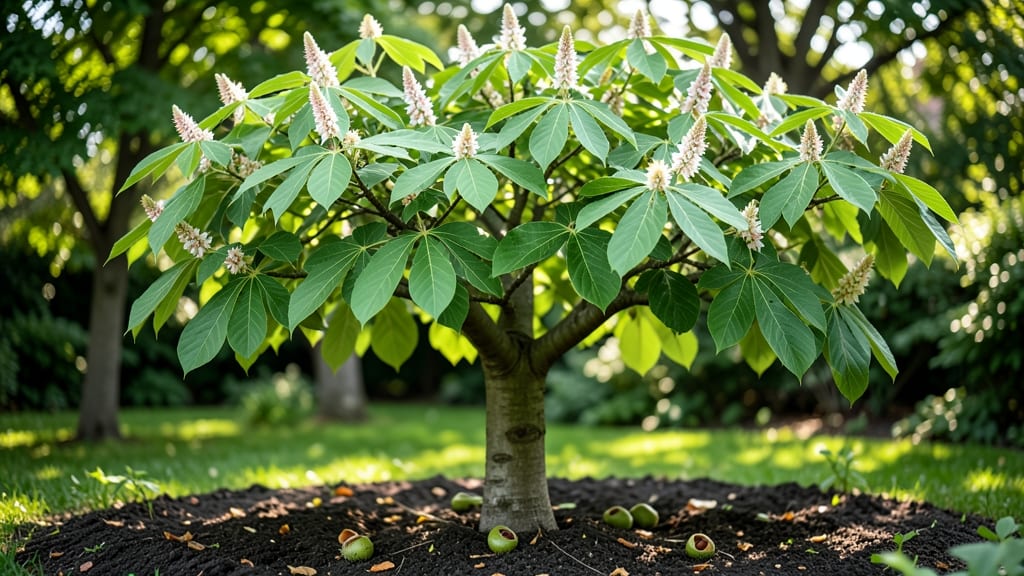
Mastering five-leaf tree identification can feel like solving a puzzle—until you spot the right clues. 🌿 I’ve spent years studying the subtle differences between maples, box elders, and even poison ivy, and the key lies in leaf arrangement, texture, and how those leaves connect to the stem.
One wrong guess could mean mistaking a prized shade tree for an allergic reaction waiting to happen.
The first step is counting leaflets: true five-leaf trees like sugar maples have smooth edges and opposite branching, while poison ivy’s leaves grow in clusters of three (but sometimes five) with jagged edges.
Bark texture and twig color also matter—maple bark is smooth and gray, while box elder bark looks rougher. Grab a magnifying glass for close-ups, and always cross-reference with a trusted app like LeafSnap or a local field guide.
Once you master these visual cues, you’ll spot the difference instantly—no more second-guessing. A red maple’s samara seeds (those helicopter-shaped fruits) or a box elder’s compound leaves will give it away.
Regional variations matter too: in the South, poison ivy thrives, while in the Northeast, sugar maples dominate. Safety first: when in doubt, snap a photo and consult an expert before touching.
This skill transforms walks into discoveries—imagine identifying a silver maple by its silvery undersides or a poison ivy by its hairy stems. Start with common species in your area, then expand. The more you practice, the faster your brain recognizes patterns. Here’s how to tell them apart for good.
The Science Behind Five-Leaf Patterns
If you’ve ever spotted a tree with five distinct leaflets and wondered why nature chose this shape, the answer lies in a mix of evolutionary advantages, botanical adaptations, and ecological strategies. While not all five-leaf trees share the same origins, their leaf structures often emerge from similar biological pressures.
Below, we break down the key reasons why these trees develop five-leaf patterns—and what it tells us about their survival tactics.
The five-leaf (or palmately compound) structure is a masterclass in efficiency. Each leaflet acts like a tiny solar panel, maximizing sunlight absorption while minimizing shading between them. Here’s how it works:
- Increased Surface Area: Five leaflets spread wider than a single leaf, capturing more light without adding bulk to the stem. Think of it like a hand fanning out—more fingers (leaflets) mean more surface area to soak up energy. 🌞
- Reduced Self-Shading: In dense canopies, overlapping leaves block light. Five leaflets angle outward, allowing sunlight to reach lower layers of the tree. This is why you’ll often see this pattern in tropical or sun-loving species.
- Flexibility in Growth: Trees in competitive environments (like forests) need adaptable structures. Five leaflets can rotate or tilt to follow the sun’s movement, a trait called heliotropism.
Actionable Tip: If you’re identifying a five-leaf tree in a shaded area, note whether the leaflets are uniformly spaced (like a horse chestnut) or uneven (like a linden). Uneven spacing often signals a tree adapted to partial shade.
Not all five-leaf trees thrive in the same conditions. Their leaf patterns often reflect local climate challenges:
| Climate Factor | How It Shapes Five-Leaf Growth | Examples |
|---|---|---|
| Humid Tropics | Thin, delicate leaflets with smooth edges reduce water loss and resist fungal growth in high-moisture air. | Mango (Mangifera indica), Breadfruit (Artocarpus altilis) |
| Dry or Arid Regions | Thicker, leathery leaflets with waxy coatings (like desert ironwood) conserve water. | Desert Willow (Chilopsis linearis), some acacia species |
| Temperate Zones | Deciduous trees (like horse chestnut) use five leaflets to balance sunlight in spring/summer while shedding them in winter to conserve energy. | Horse Chestnut (Aesculus hippocastanum), Staghorn Sumac (Rhus typhina) |
Pro Tip: 🌡️ Check the leaflet texture—smooth and thin = tropical; rough or hairy = temperate or dry-adapted. This can narrow down your identification quickly!
Five leaflets aren’t just about sunlight—they’re also a deterrent. Here’s how:
- Chemical Defense Distribution: Many toxic compounds (like tannins in sumac or alkaloids in horse chestnut) are spread across multiple leaflets. This makes it harder for insects to consume a lethal dose in one bite. 🐜
- Physical Barriers: Leaflets with serrated edges (like black locust) or sticky resins (like poison ivy) discourage chewing. Five leaflets create more edges and surfaces for these defenses.
- Regrowth Strategy: If one leaflet is eaten, the others can continue photosynthesizing. Trees like ash (Fraxinus) use this to survive grazing by deer or rabbits.
Warning: Some five-leaf trees (like poison ivy or box elder) use this structure to spread toxins. Always wear gloves when handling unfamiliar plants!
Not all five-leaf trees evolved this way by choice—some are hardwired by their genetics:
- Phyllotaxis Rules: The arrangement of leaves (or leaflets) follows a mathematical pattern called the Fibonacci sequence. Five leaflets often emerge because the tree’s meristem (growth point) naturally divides into five lobes or branches.
- Vascular Efficiency: A single stem with five leaflets requires less energy to transport water and nutrients than a pinnately compound leaf (like a maple). This is why you’ll see five-leaf patterns in fast-growing trees.
- Hybridization: Some five-leaf trees (like London planetree, a hybrid of oriental and American planetrees) inherited the trait from parent species. Crossbreeding can stabilize or enhance the five-leaf structure.
Fun Fact: 🔬 The five-leaf clover (actually a four-leaf variant!) is rare because the third leaf often fails to develop due to genetic mutations. Trees, however, rely on consistent five-leaf patterns for stability.
Quick Fixes for Five-Leaf Confusion
Identifying a five-leaf tree can feel like solving a botanical puzzle—especially when leaves look similar but aren’t quite the same! Whether you’re trying to distinguish a maple from a boxelder or confirm a horse chestnut in your yard, these practical solutions will help you nail it down fast.
Below, we break down common challenges and their fixes, plus tips to prevent future mix-ups.
Cause: Many trees have palmate (five-lobed) leaves, but subtle differences in shape, texture, or arrangement can trip you up. Fix:
- Compare leaf lobes: Count the lobes (some have 3-7) and check their depth. Deep, jagged lobes = sugar maple; shallow, rounded lobes = boxelder.
- Examine the stem: Five leaves radiating from a single point? Likely a maple or horse chestnut. If the leaves are clustered at the end of a branch, it’s probably a boxelder.
- Look for bark clues: Smooth gray bark = horse chestnut; rough, ridged bark = maple.
Prevention Tip: 📸 Snap a photo of the leaf and the bark—visual notes help later!
Cause: Young leaves often have fewer lobes or smoother edges, making them harder to ID. Fix:
- Wait for maturity: If possible, revisit the tree in late spring or summer when leaves fully develop.
- Check leaf scars: When pruning, examine the bud scale scars on branches. Maple leaves leave a U-shaped scar; boxelder scars are V-shaped.
Pro Tip: ✨ Use a leaf key app (like PictureThis or LeafSnap) to cross-reference your findings.
Cause: Some trees (like ash or sycamore) have compound leaves that look five-leafed but aren’t. Fix:
- Test the leaf structure:
- True five-leaf trees (maple, boxelder, horse chestnut) have one leaf per stem.
- Compound leaves (ash, sycamore) have multiple leaflets attached to a central stem.
- Rub the leaf: Smooth, leathery texture = horse chestnut; rough, toothy edges = maple.
Quick Check: 🔍 Hold the leaf up to light—if veins form a single central stem, it’s compound (not a five-leaf tree).
Cause: Rain, wind, or disease can distort leaf shape, making ID harder. Fix:
- After rain: Leaves may appear darker or droopier—compare to dry samples.
- Diseased leaves: Yellowing or spots? Check for anthracnose (common in maples). Healthy leaves = better ID clues.
Prevention Tip: 🌡️ Prune in dry, mild weather to avoid stressing the tree and altering leaf shape.
- Cross-reference with a field guide or online database (e.g., USDA Plants).
- Observe fruit/seeds: Horse chestnuts have spiky husks; maples produce samaras (helicopter seeds).
- Ask a local arborist if you’re still stumped—regional trees vary!
Remember: 🎯 The more details you note (leaf shape, bark, growth habit), the easier the ID becomes. Happy tree-hunting!
Frequently asked questions
What’s the quickest way to tell a maple from a boxelder?
Check the leaf lobes and bark! Maples have deep, jagged lobes (like a hand with long fingers), while boxelders have shallow, rounded lobes. Maple bark is rough and ridged, but boxelder bark looks smoother. Also, maples produce "helicopter" seeds, while boxelders have smaller, less dramatic fruits.
Can poison ivy have five leaves?
Yes—but it’s rare! Poison ivy typically grows in clusters of three leaves, but sometimes produces five-leaf clusters due to genetic variation. The key difference? Poison ivy leaves have jagged edges and grow on vines or low bushes, while maples/boxelders are true trees with smooth-edged leaflets.
Why do some five-leaf trees have hairy stems?
Hairy stems (like on horse chestnut or poison ivy) are often a defense mechanism! The tiny hairs deter insects and reduce water loss. Check the undersides of leaves too—some species (like boxelder) have fuzzy undersides, while others (like maples) are completely smooth.
Are there five-leaf trees that aren’t poisonous?
Most common five-leaf trees are safe, including sugar maples, boxelders, and horse chestnuts. The only major toxic species is poison ivy (which rarely has five leaves). Always verify by checking leaf arrangement and growth habit—trees grow upright, while poison ivy clings to surfaces.
How do I use a leaf identification app?
Start by snapping a clear photo of the leaf, bark, and any fruit/seeds. Apps like LeafSnap or PictureThis analyze leaf shape, vein patterns, and edges. Pro tip: Include a coin for scale in your photo—this helps the app gauge size accurately. For best results, take pictures on a sunny day with no shadows.