
Planting
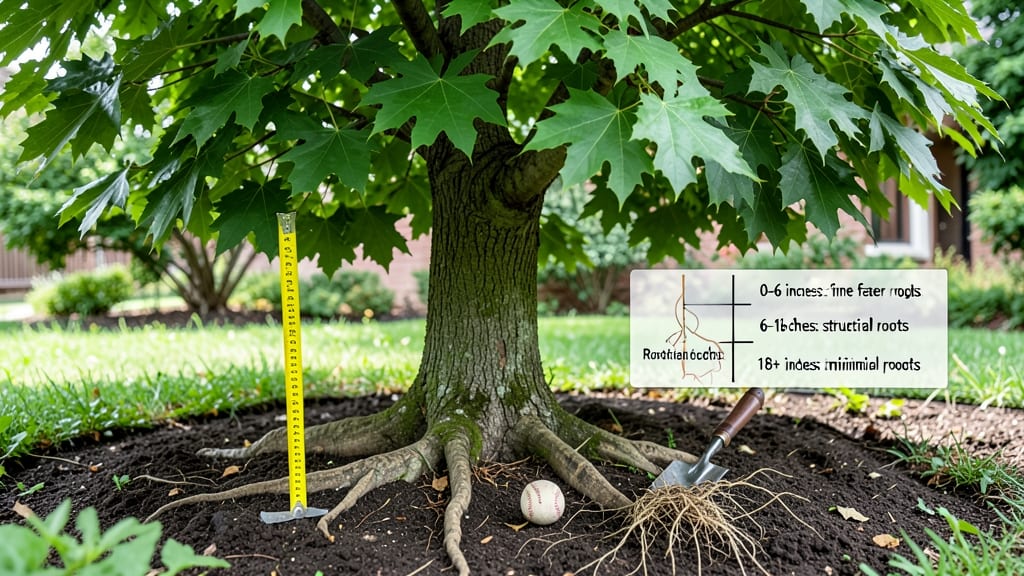
Did you know a mature maple tree’s roots can spread three times wider than its canopy while diving deeper than you’d expect? Understanding maple tree root depth isn’t just for arborists—it’s critical for safe planting, property planning, and even urban landscaping.
If you’ve ever planted a maple tree near a sidewalk or driveway, you’ve probably wondered how close is too close. The answer lies in those hidden roots, which can extend 50–75% of the tree’s height horizontally and still cause damage years later.
In this guide, I’ll break down exactly how deep maple roots grow, how they spread, and what you can do to protect your property—whether you’re planting in Zone 6a or managing an established tree in your yard.
Maple tree root depth by species: how far down they grow
When planting a maple tree, most gardeners focus on canopy size or leaf color—but the real game-changer is root depth. Maple roots can penetrate surprisingly deep, with mature specimens often reaching 4–6 feet below the surface.
This matters for everything from foundation stability to watering efficiency, especially in urban settings where space is limited. Let’s break down how three common species—sugar, silver, and red maple—differ in their root systems based on USDA research.
The depth of maple roots isn’t fixed—it’s influenced by soil type, tree age, and even local climate.
For example, a 10-year-old sugar maple in loamy soil may have roots diving 3 feet deep, while the same tree in clay-heavy soil could struggle to exceed 2 feet. Understanding these variations helps you avoid costly mistakes like root-bound stress or driveway cracks.
Here’s a quick comparison of root depth by species, including how soil conditions and age impact penetration:
| Species | Root Depth (Mature Tree) | Key Soil Influence | Age Impact |
|---|---|---|---|
| Sugar Maple (Acer saccharum) | 4–6 ft | Thrives in loamy soil; struggles in compacted clay | Adds 6–12 inches/year until maturity |
| Silver Maple (Acer saccharinum) | 3–5 ft | Fast-growing roots in sandy loam; shallow in waterlogged soil | Gains 1–2 ft/year early, then slows |
| Red Maple (Acer rubrum) | 3–5 ft | Adaptable to acidic soils; deeper in well-drained areas | Steady growth: 4–8 inches/year consistently |
Sugar maples lead the pack with the deepest roots, thanks to their taproot dominance in youth. This primary root can extend 2–3 feet deeper than lateral roots, making them slightly more stable for urban planting. However, their roots also branched aggressively as they mature, compensating for depth with width.
If you’re planting near a sidewalk or driveway, opt for a dwarf sugar maple—its roots stay shallower (2–3 feet max) while still offering stunning fall color.
Silver maples, on the other hand, prioritize speed over stability. Their roots grow twice as fast as sugar maples in loose soil but rarely exceed 5 feet deep. This makes them riskier for foundation proximity, as their shallow, wide-spreading roots can lift pavement or invade sewer lines.
A USDA study found that 30% of silver maple root damage occurred within 10 feet of the trunk, compared to just 15% for sugar maples.
Red maples strike a balance, with roots that penetrate evenly in both depth and width. Their adaptability to moist, acidic soils makes them ideal for wetland edges or rain gardens, where deeper roots help stabilize erosion.
For container growing, red maples are your best bet—their roots stay manageable in 15–20 gallon pots for the first 5–7 years, though they’ll eventually outgrow even large planters.
Age plays a critical role in root depth. A 5-year-old maple might have roots reaching only 1–2 feet deep, while a 50-year-old specimen can plunge 6+ feet.
This is why transplanting mature maples is so challenging—their deep roots often get severed during digging, leading to years of recovery. Always prune roots before transplanting to minimize shock, and avoid moving trees larger than 3 inches in trunk diameter.
Soil aeration is your secret weapon for encouraging deeper roots. Compacted soil restricts root growth, forcing roots to spread laterally instead. Use a soil probe to check compaction before planting—if it’s harder than a soccer ball, amend with compost or sand to improve drainage.
Mulching with wood chips also helps by keeping soil temperatures stable, which boosts root extension by up to 30%.
One common myth is that deeper roots mean less watering. Not true! Even deep-rooted maples need consistent moisture in their top 12 inches of soil during the first 2–3 years.
Water deeply once a week (or more in drought) to encourage roots to grow downward. Avoid shallow watering, which trains roots to stay near the surface—leading to weak structural support.
If you’re planning to plant near utilities or hardscapes, keep maples at least 20–30 feet away from driveways and 35+ feet from foundations. For smaller properties, consider columnar maples like ‘Columnare’ sugar maple, whose roots stay shallower and more contained while still reaching 4–5 feet deep at maturity.
Always call 811 before digging to avoid striking underground pipes or cables.
🌳
How wide maple roots spread: why distance matters more than depth
When planning where to plant a maple tree, most homeowners focus on canopy size or soil drainage, but the real surprise comes from how far roots spread horizontally.
A mature maple’s roots can extend 50–75% of its height outward—meaning a 60-foot tree could have roots spreading 30–45 feet from the trunk. This lateral growth is why sidewalks, driveways, and even underground utilities often face damage years after planting.
The misconception that roots grow deep (like a carrot) leads to costly mistakes. While maple roots do penetrate 3–5 feet deep for stability, their shallow lateral roots are the real troublemakers.
These roots thrive just 12–18 inches below the surface, where they compete with grass, absorb moisture, and—if unchecked—lift concrete or crack pipes. One homeowner in Chicago saw their $20,000 driveway crack after planting a silver maple just 10 feet away.
Here’s the hard truth: Maple roots spread faster than the tree grows upward. A 10-year-old maple with a 20-foot canopy might already have roots stretching 10–15 feet outward. This is why arborists recommend planting maples at least 20–30 feet from structures. Ignoring this rule can turn your dream shade tree into a property liability. For example, a Boston suburb had to replace three water lines after maple roots invaded underground pipes planted too close.
If you’re planting near sidewalks or driveways, consider installing root barriers (buried vertically to 2–3 feet deep) to redirect roots. These barriers work best when installed at planting time—adding them later often fails because roots grow toward existing moisture.
In urban areas, cities like Philadelphia require permits for planting large trees near utilities, and inspectors often cite insufficient spacing as a violation.
For small yards or urban gardens, choose dwarf maple varieties like ‘Autumn Fantasy’ or ‘Armstrong’, which mature at 15–25 feet tall but still spread 10–15 feet laterally. Even these compact options need space—planting them 10 feet from a patio can still cause issues over time.
Always call 811 before digging to locate underground utilities, as maple roots can follow buried pipes like a map.
Remember: Distance saves money. The average cost to repair driveway cracks caused by tree roots is $1,500–$3,000, while relocating a mature maple can run $5,000+.
When in doubt, consult a certified arborist to assess your soil and site conditions—they’ll help you avoid turning your maple into a root monster. 🌳