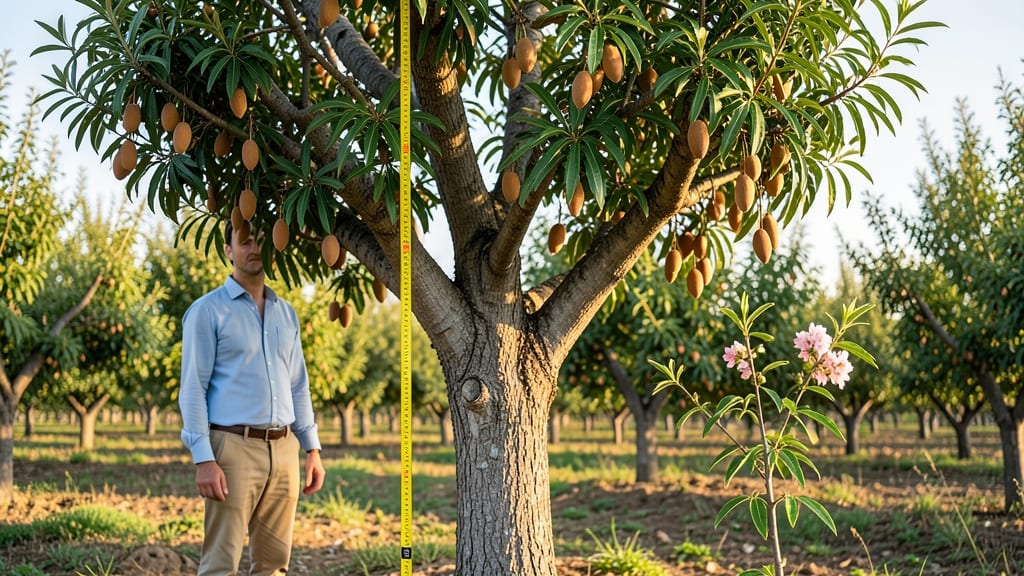
An almond tree grows to heights between 20 and 40 feet at maturity, depending on the variety and growing conditions 🌰 — which means your backyard orchard plans might need more space than you think.
Wondering whether your backyard can accommodate an almond tree? The size of a mature almond tree isn’t just about height—it’s about variety, spacing, and long-term growth habits that determine whether your orchard dreams become a reality.
Standard varieties like Nonpareil can reach 30 to 40 feet, towering over most homes, while dwarf varieties stay between 12 and 20 feet, making them perfect for smaller gardens or containers. Proper spacing is key to ensuring healthy growth and fruit production.
Below, I’ll break down the mature sizes of popular almond varieties, spacing recommendations for home gardens and orchards, and practical tips for managing growth—so you can plan your almond tree with confidence.
Mature height and spread of almond trees by popular varieties
Choosing the right almond tree variety is crucial for planning your orchard or backyard space. Standard varieties like Nonpareil can reach towering heights of 30-40 feet, while dwarf varieties stay compact at 12-20 feet.
These differences dramatically impact your orchard layout, maintenance needs, and even harvest accessibility. Understanding each variety’s growth habits helps you select trees that fit your available space and long-term goals.
The spread of an almond tree is just as important as its height. A wide canopy means more shade but also requires careful spacing to prevent overcrowding. For example, Carmel trees develop a broad spread of 20-25 feet, while Butte varieties remain more compact at 15-20 feet.
These dimensions influence how many trees you can plant per acre and whether you’ll need a ladder for harvesting.
Below is a detailed comparison of 10 popular almond varieties, including their mature height, spread, and growth habits. This information is essential for calculating spacing, planning irrigation systems, and designing pruning schedules that accommodate each tree’s unique structure.
Mature Height & Spread of Almond Tree Varieties
Variety
Height (ft)
Spread (ft)
Growth Habit
Notes
Nonpareil
30-40
25-30
Vigorous Upright
Most popular commercial variety; needs strong support
Carmel
25-35
20-25
Semi-Dwarf Rounded
Excellent for home orchards; early bearer
Butte
20-30
15-20
Compact Upright
Drought-tolerant; good for dry climates
Price
25-35
20-25
Vigorous Rounded
Self-pollinating; high yield potential
Fritz
20-28
18-22
Semi-Dwarf Rounded
Cold-hardy; good for Zone 6
Sonora
25-35
20-25
Vigorous Upright
Self-pollinating; late bloomer
Peerless
20-30
15-20
Compact Rounded
Dwarf variety; great for containers
Texas
25-35
20-25
Vigorous Upright
Heat-tolerant; good for southern climates
Ne Plus Ultra
20-28
18-22
Semi-Dwarf Rounded
Self-pollinating; early ripening
Optimal spacing requirements for almond trees by growth type
Proper spacing is critical for almond trees—whether you're planting a single tree in your backyard or establishing a full orchard. Dwarf, semi-dwarf, and standard varieties require different spacing to prevent root competition, improve air circulation, and maximize fruit production.
Getting this right ensures healthy growth and easier harvests down the line.
Almond trees are notoriously competitive with their roots, so overcrowding leads to stunted growth and reduced yields. For example, standard almond trees can spread 20-30 feet wide at maturity, while dwarf varieties stay compact at 10-15 feet wide. Understanding these differences helps you plan your orchard layout efficiently.
Row spacing and tree-to-tree distance depend on the tree's growth type. Standard trees need 30-40 feet between rows and 20-30 feet between trees, while dwarf varieties can be planted 15-20 feet apart in rows spaced 12-15 feet apart. Semi-dwarf trees fall somewhere in between, requiring 20-25 feet between trees and 18-22 feet between rows.
Growth Type
Mature Height
Mature Spread
Tree Spacing (ft)
Row Spacing (ft)
Best For
Dwarf
12-20 ft
10-15 ft
15-20 ft
12-15 ft
Backyards, containers, small orchards
Semi-Dwarf
20-30 ft
15-25 ft
20-25 ft
18-22 ft
Medium orchards, home gardens
Standard
30-40 ft
20-30 ft
25-35 ft
30-40 ft
Large orchards, commercial farms
When planning your orchard, consider soil type and drainage—almond trees hate soggy roots. In heavy clay soils, increase spacing by 10-20% to reduce competition. For example, a semi-dwarf tree in clay soil might need 25 feet between trees instead of the standard 20 feet.
For urban or small-space gardens, dwarf varieties are your best bet. Plant them 15-20 feet apart in a sunny spot with well-draining soil. If you're using containers, ensure each tree has a 24-inch diameter pot and space containers 10-12 feet apart to allow for root growth.
Remember, proper spacing now saves headaches later. Overcrowded almond trees struggle with diseases, poor fruit quality, and reduced yields. Sketch your orchard layout beforehand, and always account for the tree's mature size, not just its current size.
With the right spacing, your almond trees will thrive for decades! 🌰