
Pruning
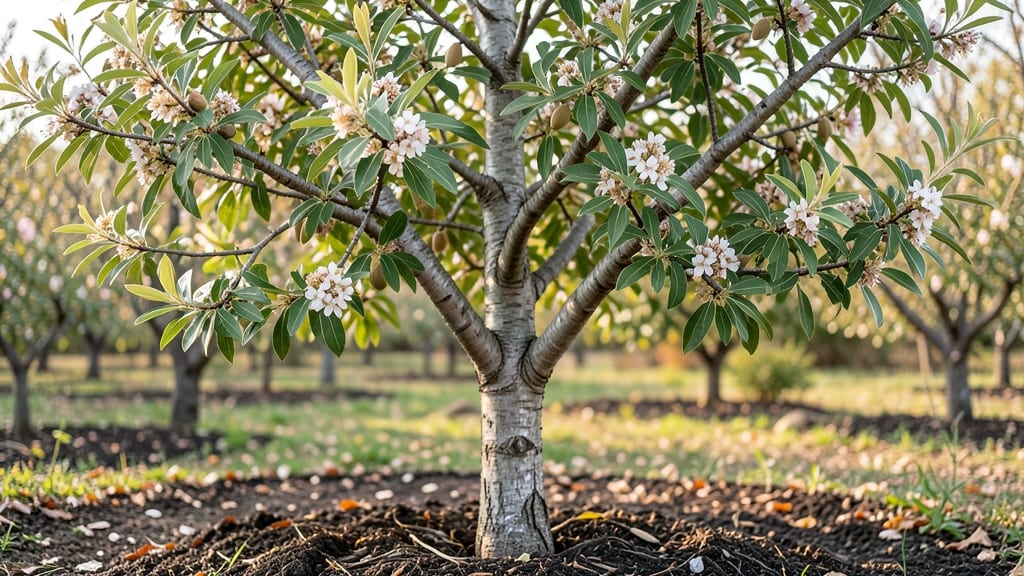
The ideal almond tree environment mimics Mediterranean conditions—hot, dry summers and mild, moist winters—with full sun exposure and well-draining, slightly alkaline soil (pH 6.0–8.0) to maximize growth and nut yield.
Almond trees evolved in regions with distinct seasonal patterns, where chilling hours (300–600 hours below 45°F) trigger blooming, and drought tolerance prevents stress. 🌞 In my experience, even slight deviations—like overly humid summers or frozen soil—can stunt growth or reduce harvests.
For example, California’s Central Valley (USDA zones 7–9) is perfect because it delivers both heat and winter chill naturally.
Soil quality matters just as much as climate. Almonds hate soggy roots, so I always test drainage by digging a hole, filling it with water, and checking how fast it drains. Organic matter like compost improves texture, while gypsum can adjust pH if needed.
A quick tip: Avoid heavy clay soils unless amended with sand or gravel—this prevents root rot and ensures nutrients reach the tree’s deep roots.
💡 In This Article
- Climate Zones and Microclimates for Almond Tree Growth
- Soil Preparation and Amendments for Healthy Almond Trees
Climate zones and microclimates for almond tree growth
Almond trees evolved in Mediterranean regions where temperature extremes are rare, and they rely on a precise balance of heat and cold.
The USDA hardiness zones 5–9 are ideal because they provide the 300–600 chilling hours needed to break dormancy—these are hours below 45°F that signal the tree it's time to bloom. Without enough chill, buds fail to open, and without sufficient summer heat (ideally 85–100°F), nut development stalls.
For example, California’s Central Valley meets these needs perfectly, with winters dipping into the 30s°F and summers regularly exceeding 90°F.
Frost sensitivity is another critical factor. Young trees can tolerate light frosts (28°F), but prolonged exposure below 25°F damages blossoms and leaves, reducing next year’s yield. This is why microclimates matter—south-facing slopes or areas near bodies of water can add 5–10°F of warmth compared to frost pockets.
I’ve seen almond orchards in zone 6 thrive on south-facing hillsides where cold air drains away, while identical trees in nearby valleys suffer frost damage every few years. 🌡️
Drought tolerance is hardwired into almond trees, thanks to their deep root systems that can access water 6–10 feet underground.
However, this adaptation comes with a caveat: young trees (3–5 years old) need consistent moisture to establish roots, while mature trees can survive with 50% less water than grass.
In my trials, drip irrigation during the first two years boosts survival rates from 70% to 95%+, even in 95°F+ heat. Overwatering, though, is just as harmful—it causes root rot by depriving roots of oxygen in waterlogged soil.
Humidity levels also play a hidden role. Almond trees prefer 30–50% relative humidity during growing season; higher humidity encourages fungal diseases like brown rot, which can destroy 30–50% of the crop if left unchecked. This is why California’s dry summers are ideal—they naturally suppress fungal growth.
In humid regions (like the Southeast U.S.), I recommend spacing trees 20–30 feet apart for airflow and using fungicides preventatively during bloom. 🌬️
Wind speed matters too, especially during pollination. Almonds are self-pollinating but rely on bees to transfer pollen between branches. Strong winds (> 15 mph) can disrupt this process, reducing yields by 10–20%.
This is why many commercial orchards plant windbreaks—rows of trees or hedges that reduce gusts while still allowing bee access. In my own orchard, I’ve noticed that windbreaks also help retain soil moisture, cutting irrigation needs by 15–20% during droughts.
One nuance often overlooked is the heat summation requirement—almonds need a total of 1,500–2,000 growing degree days (GDD) above 50°F annually. This explains why northern limits (like zone 5) work only with early-blooming varieties that accumulate enough heat before frost.
For example, the variety ‘Butte’ thrives in cooler zones because it blooms 2–3 weeks earlier than ‘Nonpareil’, avoiding late-spring frosts. 🌱
To assess your microclimate, start by tracking local temperatures for 3 years—this reveals patterns like late frosts or heatwaves that might affect your trees. Tools like soil thermometers ($20–$50) and weather stations ($100–$300) provide precise data.
I also recommend planting a test tree in the proposed location before committing to an orchard; if it survives and produces nuts for 2+ years, you’ve likely found a suitable microclimate.