
Plants
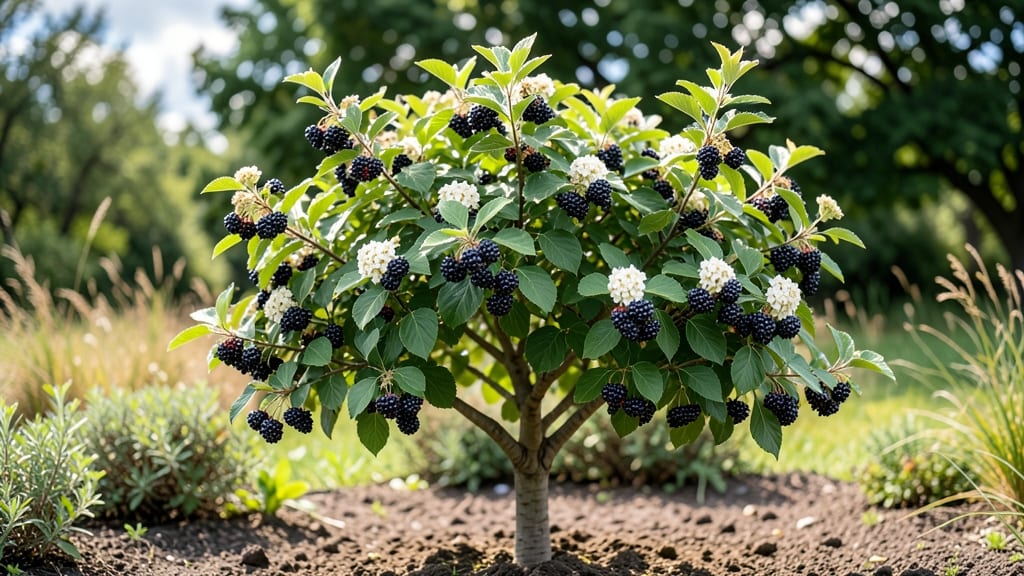
A chokeberry tree looks like a small, dense shrub or tree with dark green, oval leaves that turn brilliant red in autumn. Its smooth gray bark and clusters of dark purple-black berries distinguish it from other fruit-bearing plants, though its thorny branches can be sharp.
A chokeberry tree's visual charm lies in its layered seasonal transformation. 🌿 In spring, delicate white flowers bloom before the glossy green leaves emerge, creating a striking contrast. Summer reveals dense foliage with oval-shaped leaves that develop a rich red hue by autumn, while winter showcases its smooth gray bark.
The clusters of dark purple-black berries—often mistaken for blackberries—are actually a key identifier, hanging in tight bunches that persist through winter.
What sets chokeberry apart is its growth habit: it typically grows as a multi-stemmed shrub reaching 6-12 feet tall, though it can form small trees under ideal conditions. The thorny branches, while protective, make pruning a careful task.
I've found these trees thrive in full sun to partial shade, making them excellent landscape additions for those seeking both beauty and edible benefits.
The berries themselves are a standout feature—they're not just visually striking but also packed with antioxidants. 💫 While they're tart and astringent raw, cooking transforms them into a delicious jam or syrup. This dual-purpose nature makes chokeberry trees a favorite among gardeners who appreciate both ornamental and practical value.
💡 In This Article
- Identifying Chokeberry Tree Features by Season
- Chokeberry Tree vs. Similar Berries: How to Tell Them Apart
Identifying chokeberry tree features by season
Spring brings the chokeberry tree's most delicate display: clusters of 5-petaled white flowers with yellow centers that appear before the leaves. These flowers, measuring about 0.6-0.8 inches wide, are highly fragrant and attract pollinators like bees and butterflies.
The blooms emerge from the tree's reddish-brown buds along the branches, creating a soft contrast against the emerging foliage.
By summer, the tree transforms into a dense, leafy green canopy with simple, oval-shaped leaves that measure 1.5-3 inches long and 1-1.5 inches wide. The leaves have a slightly serrated edge and a leathery texture that feels firm to the touch.
This is also when the tree's dark purple-black berries begin to form in tight clusters, starting as green and gradually darkening as they ripen.
Autumn is when chokeberry trees truly shine, as their leaves turn a vibrant crimson red that rivals maple trees. The berries reach full maturity, developing a waxy coating that makes them appear almost blue-black in sunlight.
These 1/4-inch diameter berries grow in 2-4 inch long clusters that hang like natural ornaments, often persisting through winter until birds or humans harvest them.
Winter reveals the tree's smooth gray bark that develops subtle horizontal lenticels (pores) as it matures. The bark's texture is slightly rough to the touch, with a silvery-gray hue that contrasts beautifully with snow.
The thorny branches, which can grow up to 2-3 inches long, become more prominent in winter when the tree is bare, serving as a natural defense mechanism against herbivores.
The chokeberry tree's growth habit is another seasonal clue: it typically grows as a multi-stemmed shrub reaching 6-12 feet tall and 4-8 feet wide, though it can form small trees under optimal conditions.
In spring, new growth emerges from the base, while mature branches develop a zigzag pattern that's distinctive when viewed from below.
What's particularly fascinating is how the tree's features change with age. Young trees have thinner, more flexible branches with fewer thorns, while mature specimens develop a more rigid structure with thicker bark and denser berry clusters.
This gradual transformation makes chokeberry trees equally beautiful at every stage of their lifecycle. 🌿