
Pruning
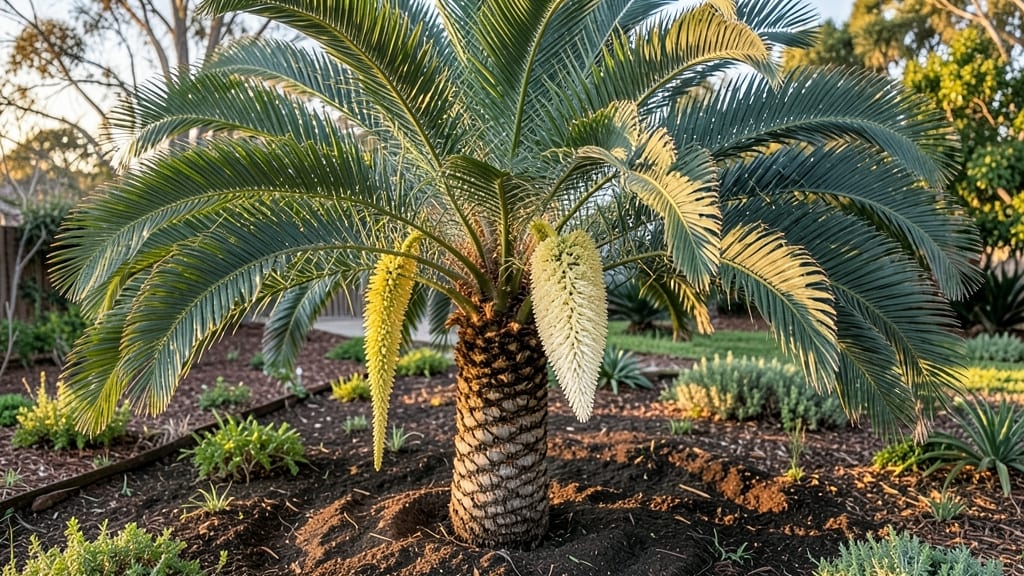
To identify male palm trees, look for smooth grayish bark and long, drooping flower clusters (spathes) that emerge from the trunk base and release pollen. Female palms develop round fruit clusters instead.
Male palm trees often have a distinctive smoother bark texture compared to females, which can develop rougher patches as they age. 🌿 The key difference lies in their reproductive structures—males produce those iconic drooping spathes that release clouds of pollen, while females develop those recognizable fruit clusters that eventually turn into dates or other palm fruits.
This visual distinction becomes especially clear during flowering season, when the gender-specific features are most pronounced.
Understanding these botanical differences helps gardeners make informed decisions about planting and maintenance. For example, if you're looking to add a palm that won't produce messy fruit or attract wildlife, male varieties might be preferable.
However, female palms often have more ornamental value due to their fruit clusters, which can create beautiful visual interest in landscapes.
💡 In This Article
- Distinguishing Male Palm Tree Bark Patterns
- Flower and Fruit Clues for Palm Tree Gender
Distinguishing male palm tree bark patterns
The bark of male palm trees typically exhibits a smoother, more uniform surface compared to their female counterparts. This smoothness comes from the male tree's growth pattern, which prioritizes vertical expansion over horizontal branching.
The bark often appears in shades of grayish-brown, with a slightly fibrous texture that's less pronounced than female bark. 🌿 For example, a California fan palm (Washingtonia filifera) male will show this smoothness more consistently than females, whose bark may develop rougher patches as they age.
Botanically, this occurs because male palms allocate more energy toward producing flowers and pollen rather than developing thick, protective bark layers.
The smoother bark also reflects a lower lignin content—the compound that gives bark its rigidity—since males don't need the same structural reinforcement as females, which bear heavier fruit loads.
In contrast, female palms often develop coarser, more textured bark with visible grooves or ridges as they mature, accommodating the weight and growth of their fruit clusters.
Color variations also provide clues. Male bark tends to maintain a more consistent hue, while female bark may darken or develop mottled patterns over time due to sun exposure and fruit production.
For instance, a Mediterranean fan palm (Chamaerops humilis) male might display a uniform silver-gray bark, whereas females often show dark brown patches where fruit has attached and fallen off. This color difference becomes especially noticeable in older specimens.
Another key observation is the growth rate of the bark. Male palms often exhibit faster vertical growth in their bark layers, creating a sleeker appearance. This is because their energy is focused on reaching reproductive maturity quickly.
In contrast, female palms grow bark more slowly in diameter but thicker in depth to support their fruit-bearing structures. The result? Male palms often look more "streamlined" and youthful in appearance, even at maturity.
For practical identification, run your hand along the trunk. Male bark will feel smoother and cooler to the touch due to its thinner, less fibrous structure. Female bark often feels rougher and slightly warmer because of increased vascular activity supporting fruit development.
This tactile difference can be particularly helpful when visual clues are obscured by foliage or distance.
One exception to this rule occurs in dioecious palm species where both genders exhibit similar bark patterns until they reach reproductive age. In these cases, you'll need to wait until flowering season to confirm gender through flower structures.
However, most common ornamental palms show these bark differences clearly from a young age.