
Pruning
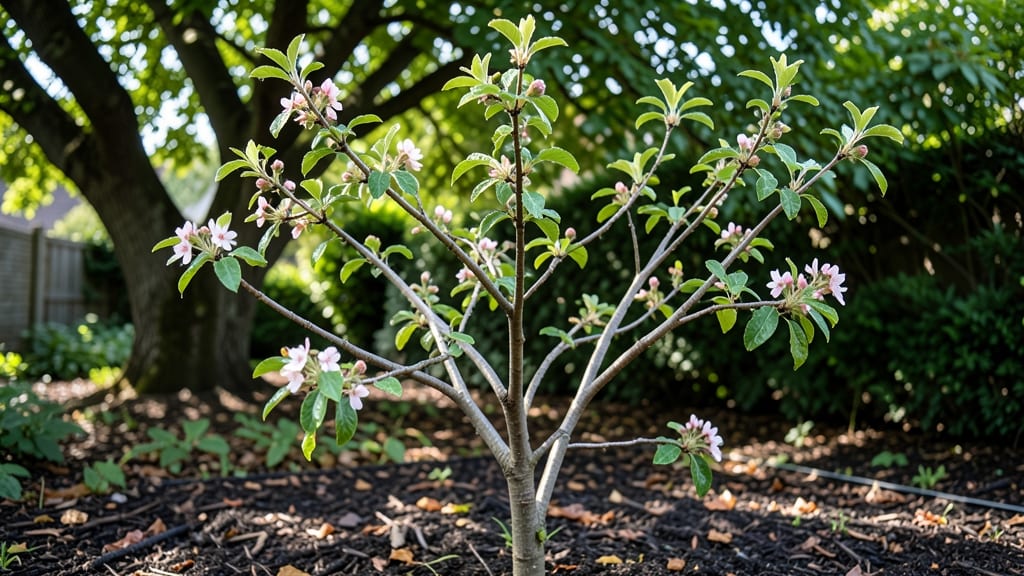
The first year with your crabapple tree sapling sets the foundation for decades of fragrant blooms and crisp fruit. ✨ I learned the hard way that strategic pruning during those early months determines whether your tree grows into a sturdy, graceful specimen or a tangled mess.
The secret isn't just cutting branches—it's shaping the root system and branch structure while the tree is still young and adaptable.
Start by preparing the planting site with well-draining soil mixed with compost, and choose a location with at least 6 hours of sunlight daily. Water deeply after planting, then maintain consistent moisture without over-saturating the soil.
The real magic happens in late winter or early spring when you prune: remove any crossing branches, weak growth, and suckers at the base, always cutting just above a bud that faces outward. This creates an open center that lets sunlight reach all parts of the tree.
Within 2-3 years, you'll see the difference—strong, upward-growing branches with proper spacing, and a root system that supports the tree through droughts and storms. The ornamental value skyrockets as the tree matures, with white or pink blossoms in spring followed by colorful fruit that persists through winter.
Plus, crabapples attract pollinators and birds, adding life to your landscape.
For container growers or small yards, dwarf varieties work beautifully, though they'll need regular pruning to maintain shape. The key is patience—don't rush the pruning process, and avoid heavy cuts that stress young trees. With the right approach, your crabapple will reward you for years to come.
📚 In This Guide
- What you need
- Instructions
- Tips and common mistakes
- Wrapping up and next steps
What you need
- ● Pruning shears: Sharp, bypass-style shears (for cuts under ½ inch thick). Quantity: 1 pair.
- ● Loppers: For thicker branches (½ to 1½ inches). Quantity: 1 pair.
- ● Hand pruners: Anvil-style for small twigs (under ¼ inch). Quantity: 1 pair.
- ● Sterilizing solution: 70% isopropyl alcohol or bleach-water mix (1 part bleach to 9 parts water). Quantity: Small spray bottle.
- ○ Pruning sealant: Optional but helpful for larger cuts (e.g., Tanglefoot Tree Wound Pruning Seal). Quantity: Small tube.
- ● Gloves: Heavy-duty, cut-resistant (e.g., Mechanix Wear). Quantity: 1 pair.
- ● Safety glasses: To protect from debris. Quantity: 1 pair.
- ● Disposable pruning bags: For collecting clippings. Quantity: 1–2 bags.
- ● Weather check: Prune on a dry, cloudy day (avoid frost or extreme heat).
- ● Tree age/health: Saplings (under 3 years old) need gentle pruning—avoid over-trimming!
- ○ Optional: Rake or broom (for cleanup).
- ● Sharpie marker (to label cuts if training branches).
- ● Tree growth regulator (e.g., Bonide Foliage Spray) for post-pruning care.
Strategic pruning guide for your crabapple sapling
Here’s how to shape your young tree for a sturdy foundation and beautiful form.
✂️ Step 1: Remove Dead or Damaged Branches First
Start by inspecting your sapling for any branches that are broken, diseased, or crossing awkwardly. These are your top priorities—removing them first keeps your tree healthy and prevents future issues. Use clean, sharp pruning shears to make a clean cut just outside the branch collar, the swollen area where the branch meets the trunk.
If a branch is larger than ½ inch thick, use loppers instead. You’ll know you’ve cut correctly when the cut is smooth and the branch falls away easily. Avoid leaving stubs—they invite rot and weak regrowth. I always disinfect my tools between cuts with rubbing alcohol to prevent spreading disease.
🌱 Step 2: Thin Out Crowded Branches for Airflow
Next, focus on thinning the canopy to improve airflow and sunlight penetration. Look for branches that rub against each other or grow inward toward the center of the tree. These are competing for space and light, which weakens the structure over time. Select the smaller or weaker branch of each pair and remove it entirely at its base.
Thinning isn’t about cutting back—it’s about creating space. Aim to remove about 20-25% of the tree’s total branches in this step. You’ll notice the remaining branches will stand taller and develop stronger growth patterns. Avoid over-thinning, though; a crabapple sapling needs a balanced canopy to support its fruit production later.
☀️ Step 3: Shape the Tree’s Structure
Now it’s time to guide the tree’s natural form. Crabapple trees benefit from an open-center shape, where the main branches spread outward like a vase. Start by identifying the strongest upward-growing branch—this will be your central leader. Remove any competing leaders that grow upward from the same point on the trunk.
For side branches, cut back any that grow at sharp angles (less than 45 degrees) to the trunk or main branches. These are more likely to break under fruit weight. Instead, encourage branches that grow outward at a wider angle. Make your cuts just above an outward-facing bud to promote healthy regrowth in the right direction.
⏰ Step 4: Prune for Root Development
While you’re shaping the top, don’t forget the roots. Pruning above ground stimulates root growth, but you can also encourage deeper roots by avoiding heavy mulch piles right against the trunk. Instead, spread mulch in a 3-inch-thick layer that starts about 6 inches out from the trunk and extends to the tree’s drip line.
Water deeply after pruning to help the tree recover. Give it 1 inch of water per week during dry spells, but avoid overwatering—soggy soil can suffocate roots. You’ll see new root growth within a few weeks, especially if you prune in early spring when the tree is just waking up from dormancy.
🌿 Step 5: Clean Up and Monitor Growth
After pruning, rake up all the fallen branches and debris to keep the area tidy. This reduces pests and diseases that might hide in the clutter. Store your pruning tools in a dry place and sharpen them before your next session. I like to schedule a follow-up pruning in late winter or early spring to remove any water sprouts or suckers that pop up.
Watch your sapling over the next few weeks. Healthy new growth should appear within 2-4 weeks, and the branches you kept should fill out nicely. If you notice any yellowing leaves or stunted growth, it might be a sign of over-pruning—next time, hold back a little more. With each pruning session, your crabapple will develop into a stronger, more graceful tree.
Tips & tricks for perfect crabapple tree pruning
These essential techniques will help you prune your sapling like a seasoned arborist—and keep it thriving for years.
Tool Prep is Non-Negotiable: Before you start, sharpen your pruning shears and disinfect them with rubbing alcohol between cuts. Dull blades tear bark instead of making clean cuts, which invites disease. I also keep a small brush handy to sweep away debris from the base of the tree—this prevents fungal spores from lingering in the soil. The ½-inch thickness rule from Step 1 is key: anything thicker needs loppers, not shears.
Visualize the Final Shape: In Step 3, when shaping your tree, imagine an open vase form before making any cuts. The strongest upward-growing branch should be your central leader—this is your tree’s backbone. For side branches, look for that 45-degree angle from the trunk; anything sharper is a weak spot waiting to snap under fruit weight. I sketch a rough outline on paper first to avoid over-cutting.
Timing Matters More Than You Think: Early spring is ideal for pruning because your sapling is just waking up from dormancy. The 2-4 week growth window mentioned in Step 5 is your reward for timing it right—you’ll see fresh green leaves and new shoots within weeks. Avoid pruning in late summer or fall; new growth won’t harden off before winter, leaving tender branches vulnerable to frost damage.
Mulch Like a Pro: That 3-inch-thick layer of mulch in Step 4 isn’t just decoration—it’s insulation. Spread it in a donut shape starting 6 inches out from the trunk to prevent rot. I use shredded hardwood mulch because it breaks down slowly and improves soil structure over time. Water deeply after mulching to help it settle and lock in moisture for those critical root development weeks.
Pro Tips for Crabapple Tree Sapling
- These essential techniques will help you prune your sapling like a seasoned arborist—and keep it thriving for years.
- Tool Prep is Non-Negotiable: Before you start, sharpen your pruning shears and disinfect them with rubbing alcohol between cuts.
- Visualize the Final Shape: In Step 3, when shaping your tree, imagine an open vase form before making any cuts.
Frequently asked questions
Got questions about nurturing your crabapple tree sapling? You’re not alone! Here are answers to the most common concerns—from pruning tips to long-term care—so you can grow a thriving tree with confidence.
When is the best time to prune a young crabapple sapling?
Prune your sapling dormant season—late winter or early spring (before buds swell). Avoid heavy pruning in fall, as wounds may not heal before cold weather. Light shaping in summer (after flowering) is fine, but focus on structure early to prevent future issues. Pro tip: Use clean, sharp tools to minimize stress!
How do I protect my sapling from winter damage?
Young crabapples are vulnerable to cold snaps. Mulch the base (2–4 inches of organic mulch) to insulate roots, and water deeply before the first hard freeze to encourage root resilience. Wrap the trunk with tree guard if rabbits or rodents are a threat. Avoid heavy snow buildup on branches—gently brush it off to prevent breakage.
Can I prune too much? What are the signs?
Yes! Over-pruning stresses saplings, leading to stunted growth, weak branches, or disease susceptibility. Signs include excessive leaf drop, stunted buds, or sap oozing from cuts. Limit pruning to no more than 25% of the foliage in a single session. If you’ve already overdone it, focus on hydration and fertilization to recover.
Are there alternatives to crabapple trees for small yards?
Consider dwarf fruit trees (like columnar apples or pears), ornamental cherries, or compact flowering trees (e.g., Japanese maple). These require less space and similar care. For pollinators, serviceberry or dogwood saplings are great low-maintenance options. Always check your USDA hardiness zone for matches!
Why are my sapling’s leaves curling or yellowing?
Curling/yellowing often signals pests (aphids, mites) or disease (fire blight, powdery mildew). Inspect undersides of leaves for bugs or webbing. Treat pests with neem oil or insecticidal soap. For disease, prune infected branches 6 inches below damage and sterilize tools. Improve airflow by thinning dense growth.
Wrapping up and next steps
Growing a healthy crabapple tree sapling starts with smart pruning—it’s your secret to strong roots and stunning branches! 🌱 By mastering the basics of when, how, and why to trim, you’ll set your young tree up for a lifetime of beauty and resilience. Remember, patience and precision pay off.
Ready to take the next step? Start small—practice on a few branches this season, observe how your sapling responds, and gradually build your confidence. Before you know it, you’ll be shaping a crabapple tree that’s the envy of the neighborhood! 🌳✨